
Energy resilience is now a security issue
Critical infrastructure owners are operating in a more exposed environment than ever before. Grid instability, extreme weather events, cyber threats, fuel dependency, and supply-chain disruption are all increasing pressure on systems that must continue to operate under degraded or contested conditions. In parallel, the concentration of global battery supply chains and growing concern around foreign-controlled software, firmware, and remote access pathways have sharpened the need for trusted alternatives.
Many infrastructure environments also impose constraints that make conventional battery systems less suitable. Fire risk, insurance limitations, software opacity, regulatory oversight, and dense or sensitive operating settings all raise the bar. In these environments, energy systems must meet higher standards of safety, transparency, cyber assurance, and long-life operational reliability.

Critical infrastructure capability built for sensitive environments
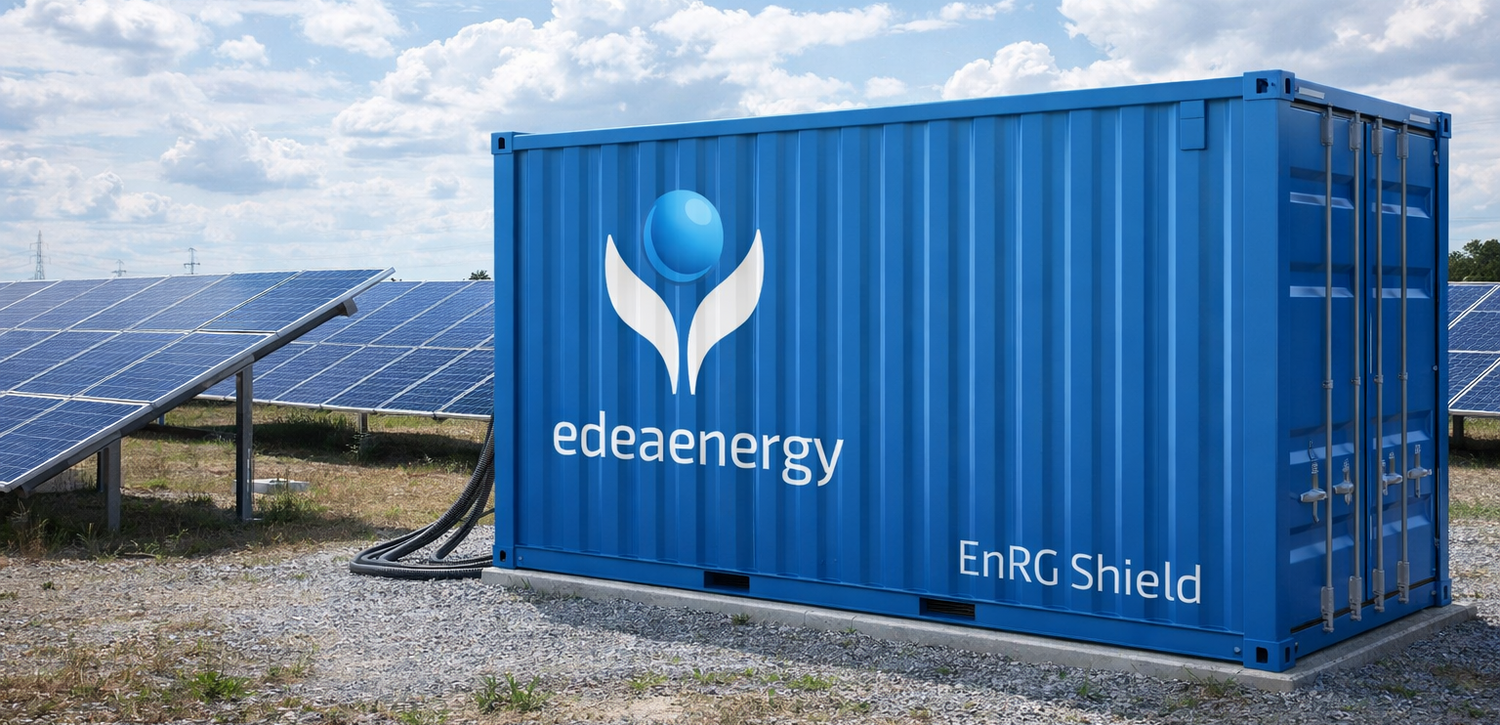
EDEA provides secure, non-flammable, cyber-secure energy systems designed for deployment in sensitive or constrained environments where conventional solutions may create unacceptable exposure. Our critical infrastructure pathway is built around the EnRG Shield platform, a containerised energy storage system designed for grid-adjacent and infrastructure applications at 500 kWh to multi-megawatt-hour scale.
Built on LFP and LTO chemistries with cyber-secure control systems, EnRG Shield supports safer deployment where fire risk, fuel dependency, foreign-controlled software, or fragile centralised infrastructure are unacceptable. At regional and grid scale, these systems can operate as distributed security assets, stabilising weak or stressed networks, absorbing volatility, and supporting continuity of essential services during outages, natural disasters, or external disruption.
Deployed as clusters, systems function as intelligent nodes that strengthen grid resilience, support black-start capability, isolate faults, and accelerate recovery without dependence on large, centralised infrastructure. This makes them relevant not only for resilience planning, but for the practical protection of essential services in real-world operating conditions.
Designed for assets that cannot fail
EDEA’s critical infrastructure solutions are relevant wherever continuity of power is treated as a matter of public safety, economic resilience, or national security. This includes power networks, water and wastewater utilities, ports, transport hubs, communications infrastructure, strategic national assets, and remote or islanded grids operating under strict reliability requirements.
These environments often require energy systems that can do more than store electricity. They must enable faster recovery, support adaptive grid architectures, manage volatility, maintain essential services during disruption, and reduce dependence on fuel logistics or high-risk external suppliers. EDEA’s approach is designed to meet those requirements through safe system architecture, trusted integration, and practical deployment models aligned to local conditions.
Designed for essential infrastructure environments


Why infrastructure operators engage with EDEA
EDEA combines Australian engineering with trusted international partnerships and a deployment model built around safety, transparency, resilience, and control. Our systems are aligned to the needs of operators and governments seeking transparent, trusted, and secure energy capability, rather than black-box platforms optimised only for commercial use cases.
By combining trusted cell pathways, defence-grade safety thinking, cyber-secure battery intelligence, QA, traceability, and practical assembly models, encrypted battery intelligence, and a trusted supply-chain model, EDEA provides critical infrastructure owners with energy systems aligned to long-term protection, continuity, and resilience objectives. This is particularly relevant for jurisdictions seeking to reduce exposure to high-risk global supply chains while strengthening control over essential services.
Trusted supply. Assured control. Practical deployment.
EDEA’s model is not dependent on immediate domestic cell manufacturing alone. It is built around a commercially realistic pathway that combines trusted international cell supply with sovereign local assembly, integration, testing, training, certification, and lifecycle support. This creates meaningful control where it matters, in system assurance, deployment readiness, cyber security, maintainability, and long-term sustainment.
For critical infrastructure owners, that means access to energy systems designed not just to perform, but to remain trusted, supportable, and strategically aligned over time.

Protecting essential services in an unstable world
As energy security and infrastructure resilience become more tightly linked, critical infrastructure owners need systems that are safe, cyber-secure, and deployable under real operational constraints. EDEA’s critical infrastructure platform is designed to help governments and operators protect essential services, strengthen resilience, and recover faster when disruption occurs.

